Assessing product opportunities
Back to the frameworks catalog
Before you lock a team onto an idea, you should be able to say out loud whether the opportunity is worth chasing. A product opportunity assessment does that: a short document for go or no-go — not a build spec.
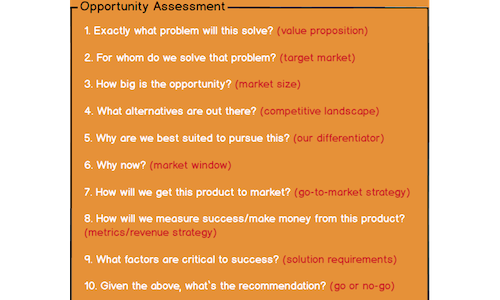
Marty Cagan and Silicon Valley Product Group put this tool against the PRD. A PRD says how you will build. The assessment asks whether you should build at all. The first job is to stop a quarter disappearing into a weak opportunity. The second is a shared picture across product, engineering, sales, and leadership.
Two to four pages is enough. If the document crosses ten pages, you are writing a spec, not an assessment.
What this assessment is not
- It is not a substitute for customer discovery. Answers should come from customer development and interviews, not from an internal debate.
- It is not a five-year business plan. Write market size only as far as it changes the decision.
- It is not a stakeholder vote. If the document only says “the CEO likes it,” you have not assessed anything.
The ten questions, with how to answer them
Cagan asks ten questions. Write the tenth last, not first.
-
Exactly what problem does this solve? (value proposition)
Write the problem in the customer’s words. “An intelligent platform for managing X” is not an answer. “At month-end the bookkeeper cannot tell which subscription is still active” is. If you already have that sentence from JTBD, paste it here. -
Who are we solving it for? (target customer)
One specific segment, not “all businesses.” Who feels the pain, has budget, and can decide now? -
How big is the opportunity? (market size)
You do not need a decorative TAM. Say how many customers, or how much usage, is plausible in 12–24 months if you win this segment. If the number is pretty only when you assume the whole country, the opportunity is small. -
What alternatives exist today? (competitive landscape)
A competitor is not only a similar startup. Excel, WhatsApp, pen and paper, or “do nothing” are often the real hire. Why do people hire those today? -
Why are we the right team? (differentiator)
Access to customers, data, a channel, technology, or brand. If the answer is “we are smart,” you do not have a differentiator. -
Why now? (market window)
What changed in behavior, regulation, technology cost, or the market to open the window? If you cannot say “why now,” you can usually wait a year — and perhaps you should. -
How will we get to market? (go-to-market)
Where do the first ten customers come from? Long enterprise sales, product-led, or a channel partner? A team without a channel sees a large opportunity on paper. -
How will we measure success and make money? (metrics / revenue)
One leading measure of customer value, and a revenue model that matches that value. Do not confuse this with a North Star. Here you only need to know what “working” means after six months. -
What factors are critical to success? (solution requirements)
Three to five conditions that kill the opportunity if they are missing: data access, a permit, an integration, a behavior change. This is not the backlog. It is the survival list. -
Given the answers, what is the recommendation? (go or no-go)
Three legal outputs: go, continue with an explicit condition, or do not go now. “Let’s do a little work and see” is not a recommendation.
How to run the meeting
One person writes a draft before the meeting. The meeting is not for decorating the text. It is for punching holes in it. Ninety minutes is enough if each question has an owner and “we will figure it out later” is not allowed.
If questions 1 or 2 are weak, stop the rest of the document. Go to customers first. If 1 and 2 are strong and 4 or 7 are weak, you can continue with a discovery condition — but write the condition down.
Do not turn the output into a PRD until a go decision exists. After go, a spec starts to mean something.
Tool: assessment worksheet
Fill the first nine questions with a note and a score from 1 to 5. The tool averages the sheet, flags critical gaps, and writes the tenth recommendation. You can copy the summary into the meeting.